
Exam Board: Pearson Duration: 2 years Entry Requirements: Grade 5-5 in Combined Science, Grade 5 in GCSE English and Grade 5 in GCSE Mathematics.
Reasons to study BTEC Applied Science
Applied Science BTEC is a challenging and interesting qualification for students with an interest in science, particularly from a practical point of view. The course reflects the fact that it is Applied Science by focusing on practical scientific investigation and work-related assignments, rather than a broad range of scientific theory for its own sake.
The BTEC in Applied Science is intended as an Applied General qualification for post-16 learners who want to continue their education through applied learning and who aim to progress to higher education, and ultimately to employment in the applied science sector.
The advantage of a BTEC means you can check your thinking and understanding with your teachers as you go along, rather than being faced with having to learn and memorise a large body of scientific theory and knowledge and then having to apply it under exam conditions to solve problems you will not have seen before.
Course Outline
Unit 1 Principles and Applications of Biology
This unit explores the key components of biological science. It will examine cells and tissues, their varied structures and functions and the biological components that interact with their existence.
Unit 2 Principles and Applications of Chemistry
Students will explore some of the fundamental concepts which underpin the chemistry and chemical reactions of the world around them.
Unit 3 Principles and Applications of Physics
Students will explore the use of practical and mathematical skills in the study of waves, motion and electricity.

Unit 4 Practical Scientific Procedures
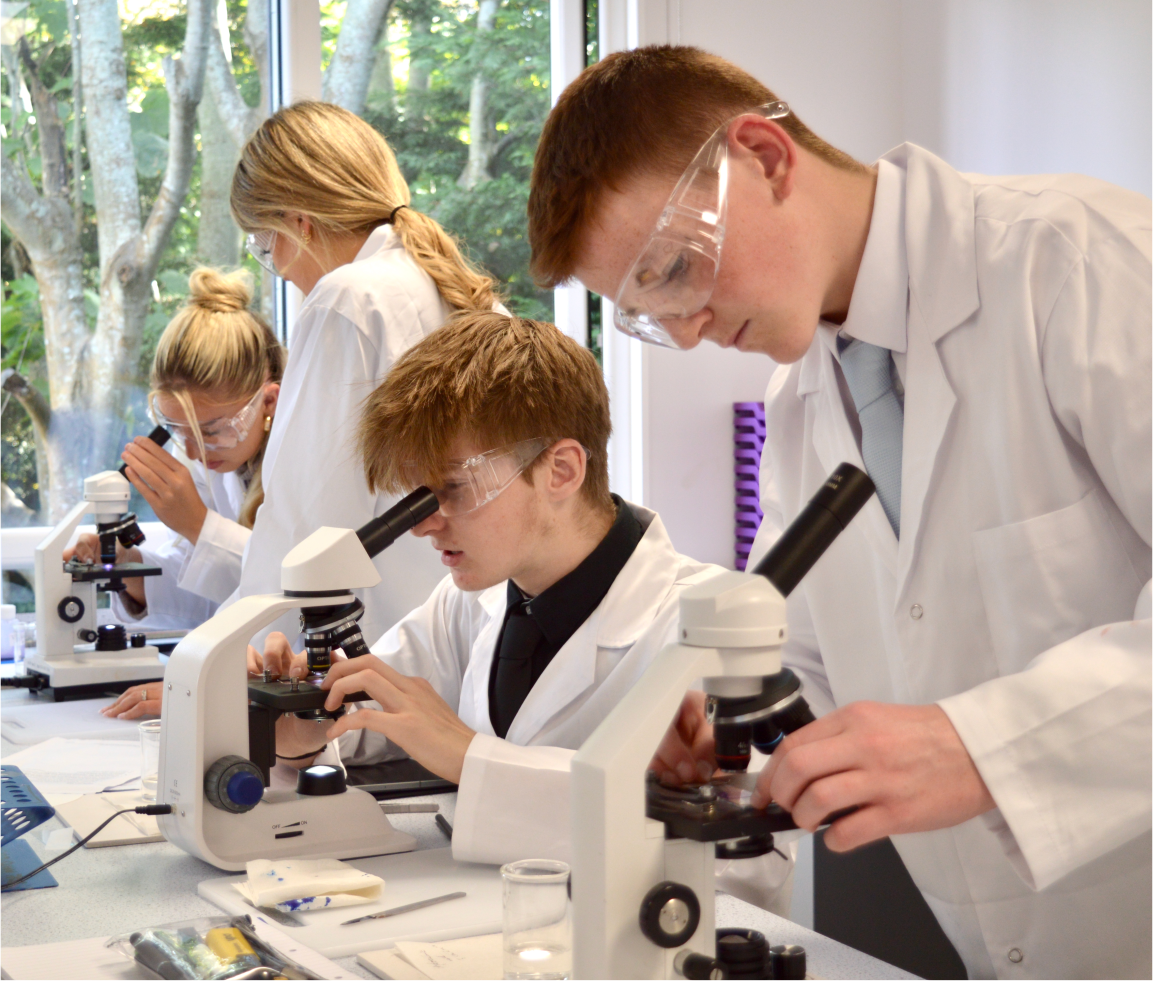
Students will be introduced to quantitative laboratory techniques, including chromatography, colorimetry and laboratory safety, which are relevant to the scientific laboratory environments.
Unit 5 Science Investigation Skills
This unit enables students to gain an understanding and the skills required to undertake an investigative project.
Assessment Outline
This is a new specification that incorporates the following methods of assessment.
1. Assessment Outline – 50% internal / 50% external
2. Units are assessed using a grading scale of: Distinction (D), Merit (M), Pass (P), Near Pass (N), and Unclassified (U).
(Near Pass is used for externally-assessed units only).
All mandatory and optional units contribute proportionately to the overall qualification grade, for example: a unit of 120 GLH will contribute double that of a 60 GLH unit.

Progression Routes and Career Paths
- Laboratory Technician
- Forensic Scientist
- Biomedical Scientist
- Environmental Scientist
- Science Teacher
- Quality Control Analyst
- Foundation Degrees
- Radiographer
- Clinical Researcher
- Midwife
- Materials Scientist
- Health and Safety Officer
- Laboratory Assistant
- Field Technician

The Romero’s Science Department
A committed team of expert teachers who share their love of their subject with passion.
Opportunities for enrichment including involvement in the Romero’s Medics Programme, which provides focussed support for those interested in a career in medicine.
A team of teachers who at GCSE have, year on year, delivered some of the strongest outcomes in the country.
First class, Science labs fully equipped with specialist equipment to complete the full range of experimental techniques.
Members of the BTEC delivery team have had extensive experience teaching BTEC Level 3 and understanding of Applied Science in a wider context.
Further Information
For more information or if you have any questions about the Applied Science BTEC course please contact:
Mr P Tadros – Subject Leader for Science [email protected]